

 Hai Nguyen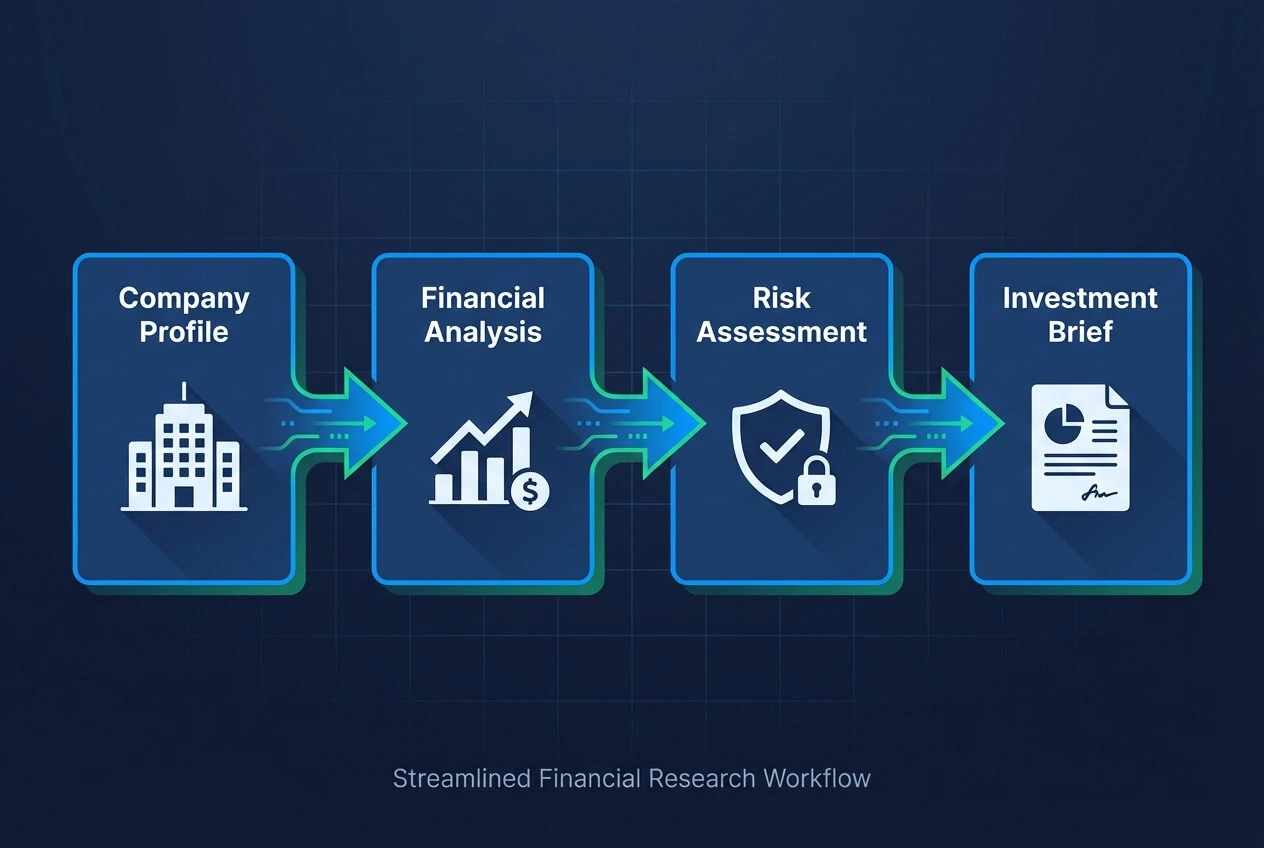
Can AI Do Stock Research?
Yes — but how you use it matters enormously. A single ChatGPT prompt asking for a buy/sell recommendation produces a confident-sounding summary that could apply to almost any company. A structured, multi-step workflow produces specific, traceable, analyst-quality output.
This guide shows the difference and walks you through a step-by-step AI stock research process you can run in minutes.
Single ChatGPT Prompt vs. Multi-Step AI Workflow
This is the most important distinction in using AI for investment research.
Single prompt approach (what most people do):
“You are a senior financial analyst. Analyze Apple and give me a buy/sell recommendation, covering revenue trends, competitive position, risks, and valuation.”
The AI responds with a structured, confident-sounding answer. The problem: it researched, analyzed, and concluded simultaneously with no separation between these roles. The risk section sounds thorough but is generic. The valuation is a guess. The output could describe almost any large tech company.
Multi-step workflow (what professional analysts actually do):
| Step | Role | Task |
|---|---|---|
| 1 | Research analyst | Build a factual company profile — no opinions yet |
| 2 | Financial analyst | Stress-test revenue, margins, balance sheet |
| 3 | Risk analyst | Identify specific risks using the prior context |
| 4 | Portfolio manager | Write the investment brief synthesizing all three |
Each step has one focused job. Each step’s output feeds into the next as context. The risk analysis is grounded in the specific financial picture. The brief is grounded in the specific risk assessment. Nothing is generic.
The output quality difference is significant — not because the AI is smarter, but because the process is.
Why Single AI Prompts for Stock Research Fall Short
Search for “best AI prompt for stock research” or “ChatGPT prompt for investment analysis” and you will find dozens of results. Reddit threads, Substack posts, and prompt-engineering blogs all offer templates that look like this:
“You are a senior financial analyst. Analyze [company] and give me a buy/sell recommendation, covering revenue trends, competitive position, risks, and valuation.”
These prompts are not useless. But they have a structural problem: they ask the AI to do too many distinct things at once in a single shot.
A real analyst does not research, analyze, and conclude simultaneously. They gather information first, then stress-test it, then form a view. Collapsing that process into one prompt forces the AI to guess at each stage rather than reason through it. The output looks thorough but is often shallow, a confident-sounding summary that could apply to almost any company.
How to Use AI for Investment Research Properly
Good financial reasoning is sequential by nature. Each conclusion depends on what came before it.
You cannot assess whether a company is fairly valued until you understand its revenue trajectory. You cannot weigh competitive risk until you have profiled the business model. You cannot write a useful investment brief until both the opportunity and the downside have been examined separately.
A single prompt skips these dependencies. A multi-step Plan respects them.
With Askimo Plans, each step is an independent AI prompt with its own focused goal. The output of each step is passed automatically to the next as context. No copy-pasting. No manually threading results together. The chain runs end-to-end and produces a final result that reflects actual staged reasoning.
How a Real Analyst Actually Thinks
Before showing how Askimo handles this, it helps to understand how a professional analyst approaches a stock.
They do not sit down and write one paragraph covering everything. They work in stages, and each stage has a different mindset:
-
Understand the business first. What does this company actually do? How does it make money? Who are its customers? An analyst refuses to form any opinion at this stage — they are just building a factual picture.
-
Stress-test the financials. Once the business is understood, they dig into the numbers: revenue trends, margins, debt levels, cash position. They look for red flags and confirm whether the growth story holds up in the data.
-
Identify what could go wrong. Only after understanding the business and the financials does the analyst assess risk: competitive threats, regulatory exposure, macro sensitivity, execution risk. With proper context in hand, the risks they identify are specific, not generic.
-
Write the investment brief. With research, analysis, and risk assessment complete, the final brief almost writes itself. It synthesizes all prior work into a clear thesis, key strengths, key risks, and a stance.
This is not just how analysts work — it is how rigorous thinking works in general. Each stage builds on the last. Skipping stages or collapsing them together leads to shallow conclusions.
How Askimo Plans Simulate This Process
Askimo Plans mirror exactly this four-stage mental model.
You provide a company name, an investment horizon, and optionally a specific area to focus on. Then the plan runs:
- Step 1 asks the AI to act as a research analyst and build a factual company profile. No investment opinion. Just the facts.
- Step 2 takes that profile and asks a financial analyst to examine revenue trends, margins, and balance sheet health. The financial analysis is grounded in the specific business profile, not generic assumptions.
- Step 3 takes both the profile and the financial analysis and asks a risk analyst to identify what could go wrong — and what could go better than expected. Because the prior context is rich, the risks are specific to this company, not boilerplate.
- Step 4 takes all three outputs and asks a portfolio manager to synthesise them into a professional investment brief with a clear stance.
Each step receives only the information it needs and has one focused job. The output of every step feeds into the next automatically. You never touch the intermediate results.
The difference from a single prompt is not cosmetic. A single prompt forces the AI to be a researcher, analyst, risk manager, and writer simultaneously, with no separation between these roles. The result is a confident-sounding summary that could describe almost any company. The Plan produces output that is specific, traceable, and defensible.
What the Output Looks Like
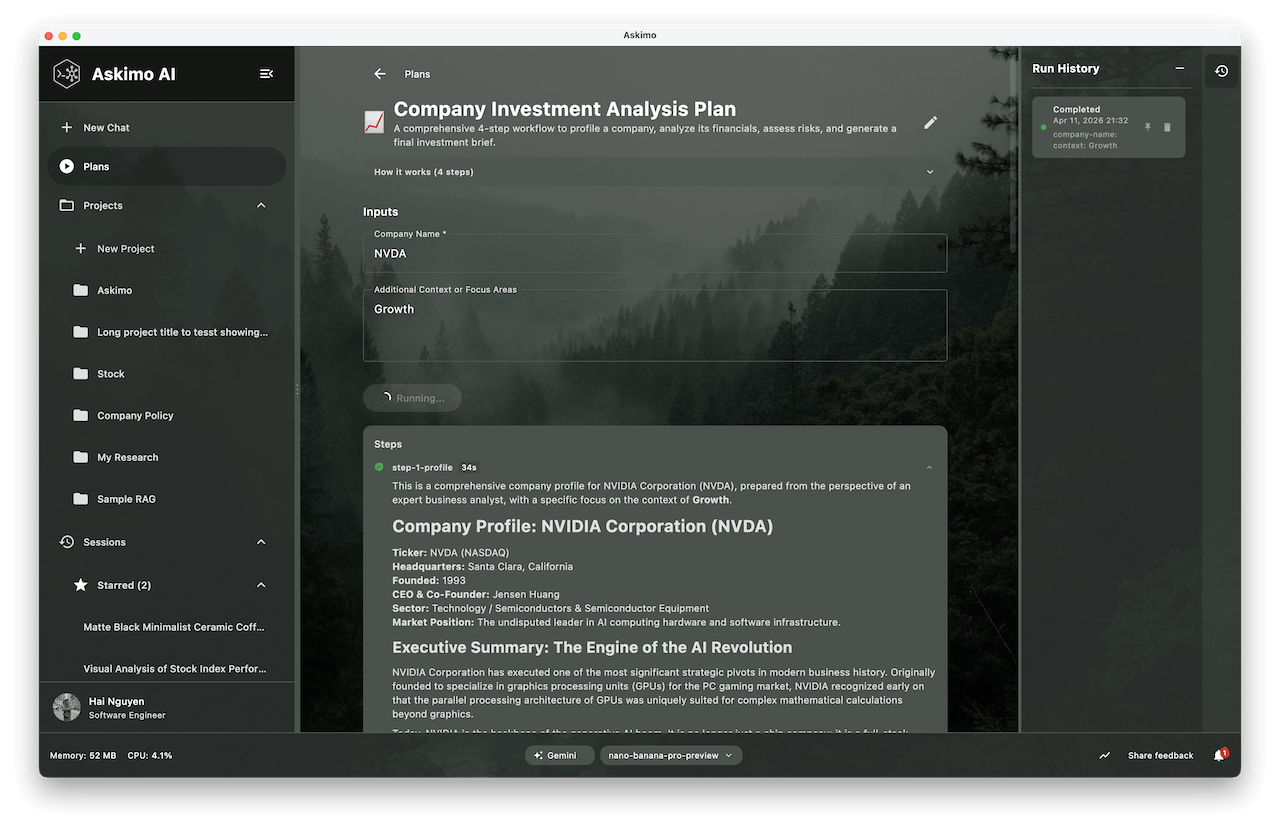
After the plan finishes, you have four structured pieces of content:
Company profile — a concise factual summary of the business model, revenue streams, markets, and strategic direction. No fluff.
Financial health analysis — a focused assessment of revenue trajectory, profitability, balance sheet strength, and any recent financial events worth flagging.
Risk assessment — specific risks for this company over your stated investment horizon, including upside risks. If you specified a focus area (e.g. “AI revenue exposure”), that gets extra attention.
Investment brief — a professional summary structured as: investment thesis, key strengths, key risks, and overall stance with a one-paragraph rationale.
This is the output you would expect from a junior analyst spending several hours on a research task. Askimo produces it in minutes, and every conclusion is traceable back to the steps that built it.
Once the plan finishes, you can also refine the result using the Follow-up field. Askimo holds the full context of the entire run in memory, so you can ask things like:
- “Make the investment thesis more concise”
- “Add a section comparing this to its closest competitor”
- “Rewrite the risk section with more focus on regulatory exposure”
- “What would need to change for the stance to shift from cautious to constructive?”
Each follow-up updates the result in place. No need to re-run the full workflow.
How Askimo Makes This Work Behind the Scenes
Behind every plan is a YAML file that instructs the AI precisely: what inputs to collect from the user, what each step should do, what persona the AI should adopt for each step, and how outputs are passed between steps.
Here is what the investment research plan looks like under the hood:
id: company-investment-analysis-planname: Company Investment Analysis Plandescription: A comprehensive 4-step workflow to profile a company, analyze its financials, assess risks, and generate a final investment brief.icon: 📈inputs: - key: company-name type: text label: Company Name hint: e.g., Apple Inc. or Tesla required: true - key: context type: multiline label: Additional Context or Focus Areas hint: Any specific aspects you want emphasized (e.g., recent acquisitions, specific market challenges). required: falsesteps: step-1-profile: system: "You are an expert business analyst." message: "Generate a comprehensive company profile for {{company-name}}. Include their mission statement, key products/services, target market, major competitors, and recent significant news or milestones. Consider this context: {{context}}." step-2-financials: system: "You are a seasoned financial analyst." message: "Based on the profile in {{step-1-profile}}, analyze the financial health of {{company-name}}. Discuss key financial metrics (revenue growth, profitability margins, debt levels, cash flow) based on recent publicly available data. Identify strengths and weaknesses in their financial structure." step-3-risks: system: "You are a risk assessment specialist." message: "Review the profile in {{step-1-profile}} and financial analysis in {{step-2-financials}}. Identify and assess the major investment risks associated with {{company-name}}. Categorize them into market risks, operational risks, financial risks, and regulatory risks. Rate the severity of each risk." step-4-brief: system: "You are a senior investment strategist." message: "Synthesize the findings from {{step-1-profile}}, {{step-2-financials}}, and {{step-3-risks}} into a final investment brief for {{company-name}}. The brief should include an executive summary, investment thesis, key risks, and a final recommendation (e.g., Buy, Hold, Sell) with a supporting rationale geared towards institutional investors."You do not need to understand or write any of this yourself.
You Do Not Need to Know YAML
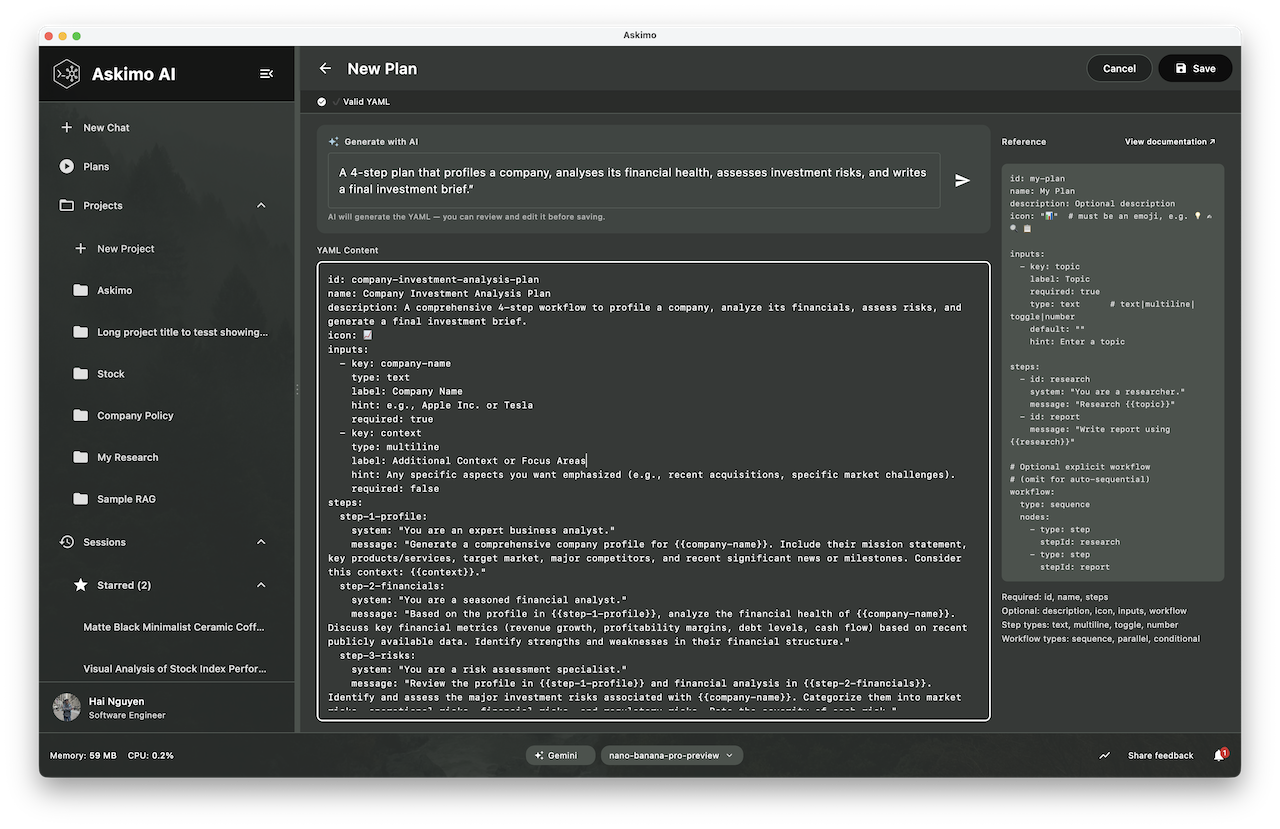
Askimo includes an AI generation panel built directly into the plan editor. You describe the workflow you want in plain English and the AI writes the entire YAML for you.
For example, you can type:
“A 4-step plan that profiles a company, analyzes its financial health, assesses investment risks, and writes a final investment brief.”
Askimo interprets your description and generates a complete, ready-to-run plan in seconds. You review it, tweak any wording if you want, and save it. From that point on, the full four-stage research workflow runs with a single click and a company name.
This is what makes Plans genuinely accessible. The analytical rigour of a multi-step professional research process, driven by a plain-English instruction, with no technical knowledge required.
Export the Brief as PDF or Word
When the result is ready, you can deliver it immediately. Askimo supports two export modes:
- Export Result — exports the final investment brief as a clean PDF or Word (.docx) file. Ready to share with a colleague, advisor, or client.
- Export Full Run — exports all four step outputs in sequence: company profile, financial analysis, risk assessment, and final brief. Useful for presenting your full reasoning chain or building a research archive.
No formatting required. No copy-pasting into Google Docs. The report goes from AI to a shareable file in one click.
Building Your Own Variant
The plan above is a starting point. You can adapt it by describing what you want to the AI generator:
- “Add a valuation step that estimates fair value using comparable multiples”
- “Add a news and sentiment step before the financial analysis”
- “Add a portfolio fit step that checks if this company suits a growth strategy”
Askimo will generate the updated YAML for you. You can also duplicate any existing plan from the gallery menu and edit from there.
Try It: AI-Powered Stock Research in Askimo
Askimo Desktop is free to download and works with OpenAI, Claude, Gemini, Ollama, and other providers. Plans, AI generation, follow-up conversations, and PDF/Word export are all included.
Download Askimo Desktop and run your first investment research plan in under five minutes.
The same multi-step approach works for any domain where staged reasoning matters: competitor analysis, due diligence, academic research, and more. The built-in plan library covers several of these out of the box, and you can build your own using nothing but plain English.
Support Askimo on GitHub
Askimo is an open-source project built to help people work more effectively with AI.
If you find Askimo useful, please consider visiting the GitHub repository and giving it a star ⭐. Your support helps the project grow and encourages continued development.
Frequently Asked Questions
Can AI do stock research? Yes. AI can profile a company, analyze its financial health, assess investment risks, and write a professional brief — but the quality depends heavily on how you structure the task. A single prompt produces generic output. A multi-step workflow where each stage builds on the last produces specific, traceable, analyst-quality results.
Is ChatGPT good for investing? ChatGPT is useful for individual research tasks but struggles when asked to do everything at once. Asking it to simultaneously research, analyze financials, assess risk, and recommend in one prompt forces it to skip the dependencies between those stages. You get better results by splitting the work across focused steps — which is exactly what a multi-step AI workflow does.
How do I use AI to analyze a stock? The most effective approach mirrors how professional analysts work: (1) build a company profile, (2) analyze financial health using that profile as context, (3) assess risks using both the profile and financials, (4) write the investment brief synthesizing all three. Tools like Askimo Plans automate this entire chain — you provide a company name and the workflow runs end-to-end.
What is the best AI prompt for stock research? No single prompt does this well. The best approach is a sequence of focused prompts, each with a specific role: research analyst, financial analyst, risk specialist, portfolio manager. Each prompt receives the output of the previous step as context. This produces output that is specific to the company, not boilerplate.
Can I use AI to do due diligence on a company? Yes. The same multi-step approach that works for stock research applies to due diligence: profile the business, examine the financials, identify risks, and synthesize. You can customize the steps to cover areas specific to your diligence checklist — competitive positioning, customer concentration, regulatory exposure, and so on.
Does Askimo work with ChatGPT, Claude, and Gemini? Yes. Askimo Desktop works with OpenAI (ChatGPT), Anthropic Claude, Google Gemini, Ollama, and other providers. You can run the same investment research workflow against any of them and compare outputs.